What Is the R4-3 Slower Traffic Keep Right Sign?
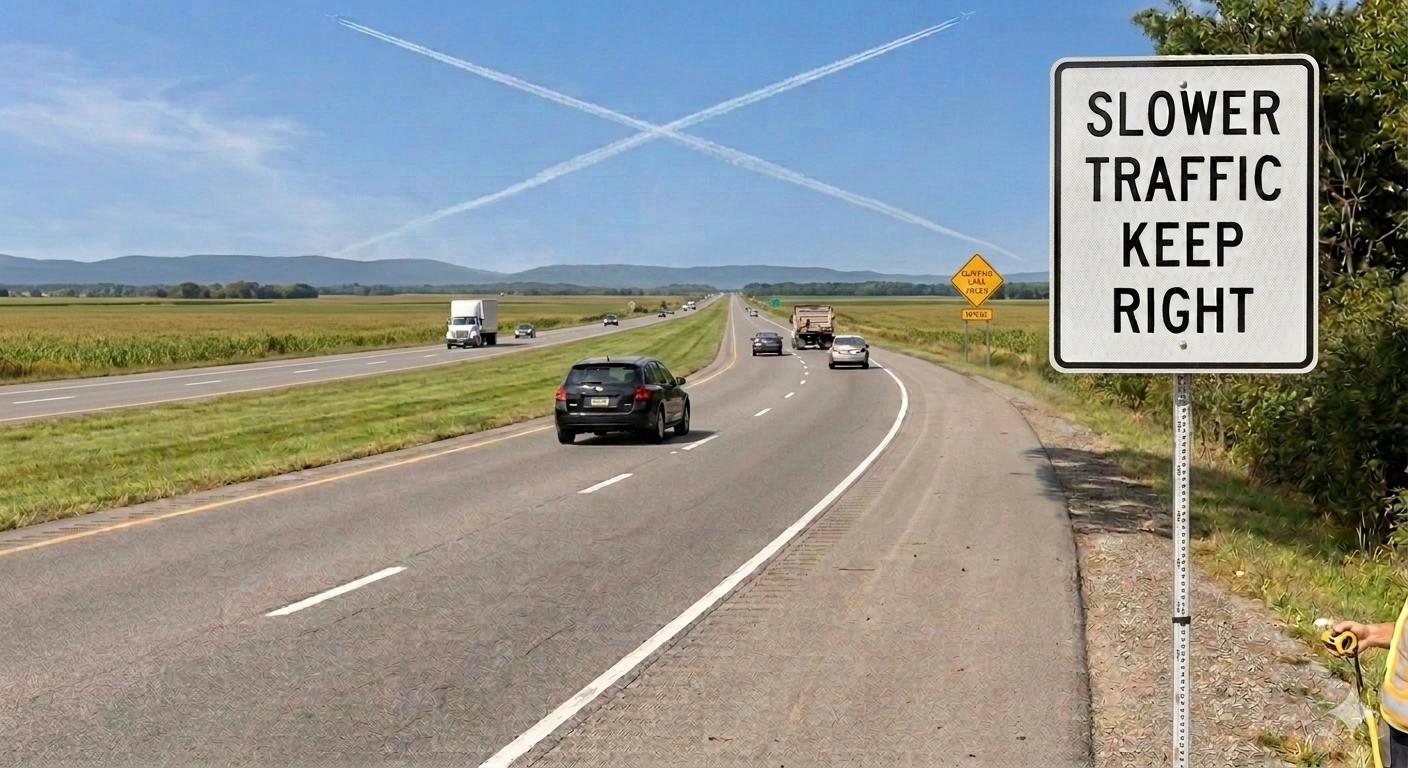
Picture a four-lane divided interstate somewhere in the American Midwest. You're in the left lane, cruising along at 60 mph. The posted limit is 70 mph. Half a mile back, a line of vehicles is stacking up behind you. And just ahead, there's a white rectangular sign on the right shoulder: SLOWER TRAFFIC KEEP RIGHT.
That's the R4-3. It is a federal regulatory sign defined and standardized in the Manual on Uniform Traffic Control Devices (MUTCD) under Chapter 2B, specifically within the R4 series — the "Passing, Keep Right, and Slow Traffic" family of signs. It is not a courtesy suggestion printed on government-funded aluminum. It is a regulatory instruction backed by state traffic law, and in an increasing number of states, ignoring it is a ticketable offense.
The sign has been part of American highway signage for decades, and it didn't change significantly in the MUTCD 11th Edition (2023). That stability isn't surprising — the message hasn't needed redesigning because the problem it addresses hasn't gone away. Left-lane camping remains one of the most commonly cited causes of highway congestion and driver frustration in the country, and the R4-3 is the primary on-road tool traffic engineers have to address it through signage.
What Does "Slower Traffic" Actually Mean?
This is where a lot of drivers get confused — and where the sign's meaning gets misread in a way that creates real friction on the road. "Slower traffic" does not mean traffic traveling below the posted speed limit. It means traffic traveling below the prevailing speed of other vehicles around you on that stretch of road at that moment.
The MUTCD does not define a specific mph threshold. There's no rule that says "if you're doing 62 in a 65, keep right." The standard is relative, not absolute. If the flow of traffic around you is moving at 72 mph and you're sitting at 60 mph, you are slower traffic — regardless of what the speed limit says. Conversely, if everyone on the highway is doing 55 mph in construction traffic, you are not slower traffic even if the posted limit is 70 mph.
"Slower traffic means slower relative to the vehicles around you — not slower than the number on a sign. The R4-3 is measuring your speed against the flow, not against a fixed threshold."— Engineer Fix, MUTCD Sign Analysis, 2026
This distinction matters enormously in practice. A driver who sets cruise control at exactly 65 mph on a 65-mph highway and refuses to move right — reasoning that they're doing the speed limit so no one has grounds to complain — is still a "slower traffic" driver if the surrounding vehicles are running at 70 mph. The R4-3 is addressed squarely at that person.
It also means the sign doesn't give faster-moving vehicles a blank check to demand that everyone move over for them. If you're doing 90 mph in a 65 mph zone and demanding the left lane to yourself, the R4-3 is not your legal backing — the vehicle you're trying to pass isn't "slower traffic" just because you're speeding.
Is It a Law or Just a Courtesy?
Short answer: it's a law. The longer answer requires understanding how MUTCD signs connect to state traffic codes.
The MUTCD is adopted by reference into each state's transportation law. When a state adopts the MUTCD, its regulatory signs — including the R4-3 — carry the force of whatever state statute governs lane usage on multi-lane highways. In nearly every state, that statute says something to the effect of: on a highway with two or more lanes for traffic moving in the same direction, slower vehicles must keep right except to pass, turn left, or avoid a hazard.
That said, enforcement varies enormously by state and by individual officer discretion. On some corridors, troopers actively target left-lane campers. On others, the sign is rarely, if ever, the basis of a stop. But the legal authority is there, and ignorance of the sign's regulatory status is not a defense.
Appearance, Shape & Color
The R4-3 follows the standard design language for regulatory signs — white background, black legend, black border, vertical rectangle. It reads as four words stacked vertically: SLOWER / TRAFFIC / KEEP / RIGHT. No symbols, no arrows, no pictograms. Just the instruction, stated plainly.
You'll notice the R4-3 runs slightly larger than the R4-2 (Pass With Care) by default. The minimum standard size is 24″ × 30″ rather than 18″ × 24″, because the R4-3 almost always appears on high-speed multi-lane roads where sign legibility must be maintained at greater distances and higher approach speeds. On Interstate highways and expressways, the 36″ × 48″ version is common.
The font is FHWA Series D — the same Highway Gothic typeface used on speed limit signs, stop signs, and most other standard road signs across America. The 11th edition of the MUTCD confirms that Clearview is no longer approved for new installations on regulatory signs, so Series D is the only compliant choice for fabricators today.
NOT
PASS
WITH
CARE
TRAFFIC
KEEP
RIGHT
RIGHT
Where Engineers Place It — and Why
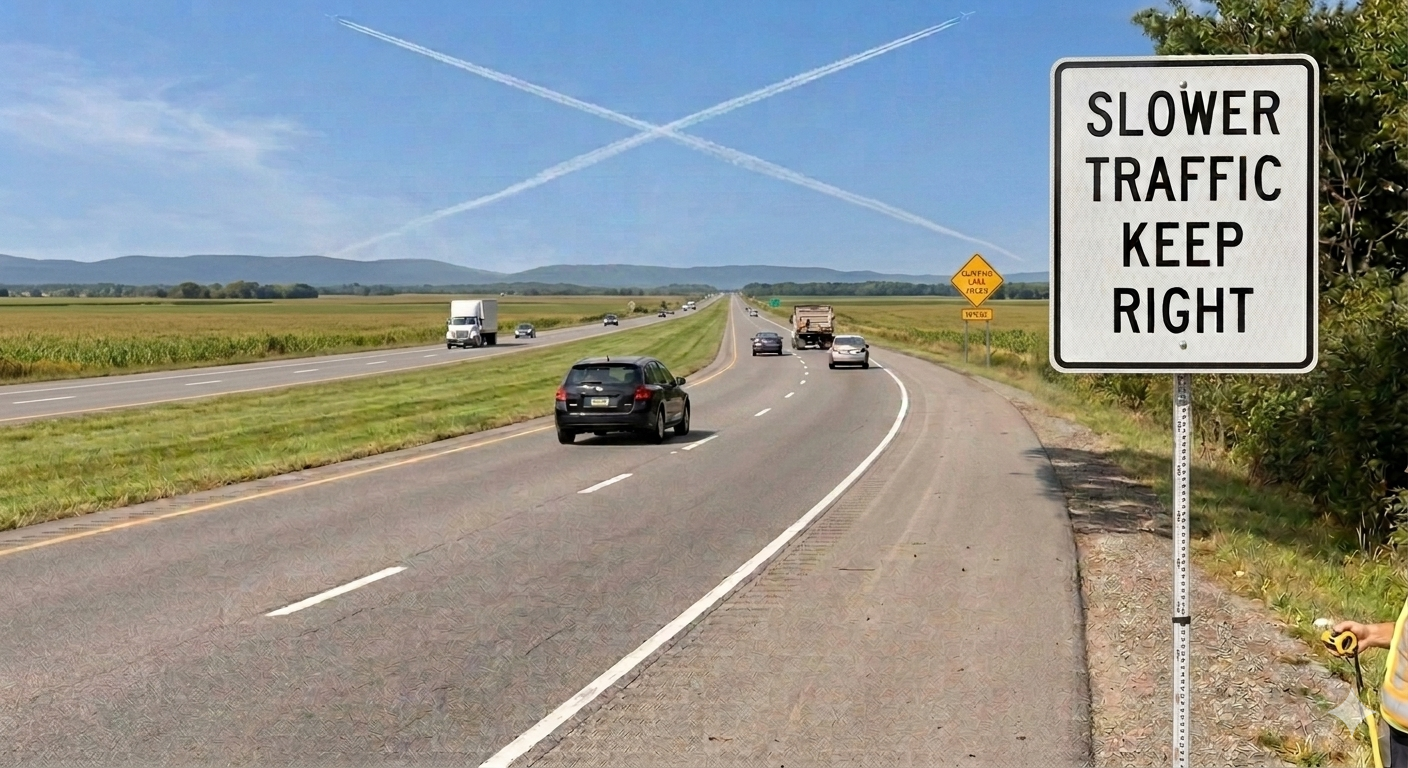
The R4-3 is almost exclusively a multi-lane divided highway sign. You won't find it on standard two-lane undivided roads, and you won't find it at intersections. Its home is the center strip of an Interstate, the median of a divided expressway, or the right shoulder of a multi-lane arterial — anywhere that has a functional concept of a "left lane" that faster traffic might need to use for overtaking.
The MUTCD gives engineers latitude in deciding exactly where to post R4-3 signs, but several placement contexts are well-established by practice:
-
Long rural Interstate stretches: Posted at regular intervals — often every 5 to 10 miles — on multi-lane highways through low-density areas where passing opportunities are plentiful but drivers may forget lane discipline on long straight sections.
-
After on-ramp merge zones: Entering traffic from ramps tends to disrupt flow in the right lane. An R4-3 posted downstream of a major interchange reminds drivers who migrated left during the merge to return right once they've settled into highway speed.
-
Climbing lanes and truck grades — mandatory: This is the one context where the R4-3 is not optional. The MUTCD 11th edition states the sign shall be required at climbing lanes — the extra uphill lane added for slow-moving trucks. Every climbing lane in the country is supposed to have one. Engineers also commonly post it in advance of the grade so slower vehicles can begin moving right before the lane split occurs.
-
Approaching urban congestion zones: On the approaches to cities where lane discipline traditionally breaks down, the R4-3 appears as a reminder before drivers hit the more complex signage of urban interchanges.
-
Following construction zone exits: Work zones often force all traffic into fewer lanes and destroy normal lane separation habits. An R4-3 at the end of a work zone restoration helps drivers re-establish proper lane discipline.
MUTCD Specifications (Size & Retroreflectivity)
The 11th edition of the MUTCD maintains the R4-3's specifications largely unchanged from prior editions. Here's where it sits relative to the rest of the R4 sign family:
| Sign Code | Sign Name | Standard Sizes | Min. Retroreflectivity (RA) | 11th Ed. Status |
|---|---|---|---|---|
| R4-1 | Do Not Pass | 18″×24″ / 24″×30″ / 36″×48″ | 7.0 cd/lux/m² (white) | No Change |
| R4-2 | Pass With Care | 18″×24″ / 24″×30″ / 36″×48″ | 7.0 cd/lux/m² (white) | No Change |
| R4-3 | Slower Traffic Keep Right | 24″×30″ / 36″×48″ | 7.0 cd/lux/m² (white) | No Change |
| R4-7 | Keep Right | 18″×24″ / 24″×30″ | 7.0 cd/lux/m² (white) | No Change |
| R4-16 | Keep Right Except to Pass | 12″×18″ / 18″×24″ / 24″×30″ | 7.0 cd/lux/m² (white) | No Change |
R4-3 vs. R4-7 Keep Right — What's the Difference?
These two signs get confused constantly, and it's understandable — they're both white rectangular regulatory signs that tell you to stay right. But they mean very different things, and they're placed in completely different contexts.
- Applies to all traffic, regardless of speed
- Directs drivers to pass to the right of a specific physical feature — an island, a median, a gore point, a divided highway separator
- Often found at highway entrances, median openings, and channelized intersections
- No speed condition — everyone must comply
- Smaller standard size: 18″×24″ common
- Applies only if you are traveling below the prevailing speed of surrounding traffic
- Addresses lane discipline behavior on multi-lane open roads
- Found on Interstates, expressways, and divided multi-lane highways
- Speed-conditional — if you're keeping pace with traffic, you may use any lane
- Larger standard size: 24″×30″ minimum
Think of it this way: the R4-7 is a directional instruction about a physical feature in the road ("go right of this thing"). The R4-3 is a behavioral instruction based on your speed relative to other vehicles ("if you're slow, be in the right lane"). One has nothing to do with your speedometer. The other is entirely defined by it.
A stricter sign in the R4 family — the R4-16 Keep Right Except to Pass — is the most demanding version of the concept. Where the R4-3 applies a speed-relative standard, the R4-16 flat-out tells you to occupy the right lane unless you are actively overtaking another vehicle, period. States like Indiana and Georgia have deployed the R4-16 on sections of highway where left-lane enforcement campaigns are active.
How State Laws Handle Left-Lane Camping
The R4-3 sign exists within a patchwork of state laws that vary considerably in how aggressively they enforce left-lane discipline. Understanding the legal landscape behind the sign helps explain why it's treated as gospel on some highways and largely ignored on others.
-
Strict enforcement states (e.g., Georgia, Indiana, New Jersey): Have enacted specific "slowpoke laws" that make it a primary offense to occupy the left lane while not actively passing. Officers can and do stop drivers based solely on this behavior. Fines range from $75 to $1,000 depending on the state and circumstances.
-
General keep-right states (most states): Have lane-usage statutes that require slower traffic to keep right but enforce the provision inconsistently. The R4-3 sign reinforces the rule, but citations are typically issued in conjunction with other violations or after a complaint-driven stop.
-
Minimum speed limit states: Some states post minimum speed limit signs on Interstate highways (e.g., 40 mph minimum on a 70 mph corridor). In these states, the R4-3 works in tandem with the minimum speed posting to create a speed band: if you're at or above minimum but below prevailing flow, you keep right. If you're below minimum, you shouldn't be on that road at all.
Common Questions Answered
Is the Slower Traffic Keep Right sign a law or just a suggestion?
It is a regulatory sign with full legal authority under state traffic codes that adopt the MUTCD. In most states, failing to keep right when traveling below the normal speed of traffic is a moving violation. The R4-3 isn't a courtesy reminder — it's a codified traffic rule, and an officer can issue a citation for non-compliance in jurisdictions that enforce it actively.
Does it apply on two-lane roads?
Rarely. The R4-3 is almost exclusively used on multi-lane divided highways where there is a designated passing lane or left lane. On a standard two-lane undivided road, the concept of "keeping right" for slower traffic is still a legal obligation in most states, but it is enforced through pavement markings and passing zone signs — not the R4-3. If you're on a two-lane road moving well below traffic speed, the applicable guidance is the passing zone system, not this sign.
What's the difference between R4-3 and R4-7 (Keep Right)?
The R4-7 Keep Right sign directs all traffic to stay to the right of a specific physical obstacle — a median nose, a channelized island, a gore point at a highway split. It applies to everyone regardless of speed. The R4-3 Slower Traffic Keep Right applies conditionally: only if your speed is below the prevailing traffic flow does it require you to move right. One is a universal directional instruction. The other is a speed-conditional lane discipline rule.
How slow is "slower traffic"?
The MUTCD does not define a specific mph threshold. "Slower traffic" means any vehicle traveling materially below the normal speed of other vehicles on that road at that time. If traffic around you is moving at 70 mph and you are doing 55 mph, you are slower traffic. If everyone is doing 55 mph in heavy volume, you are not slower traffic even if the posted limit is 65 mph. The benchmark is always the flow around you, not the number on the speed limit sign.