What Is the R4-9 Stay in Lane Sign?
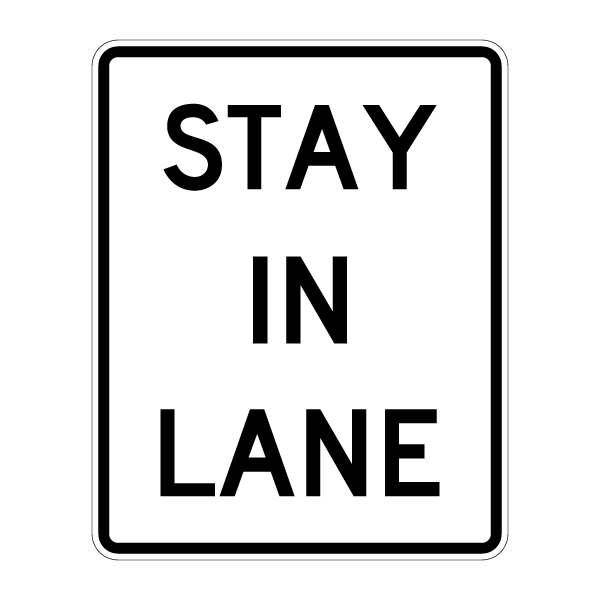
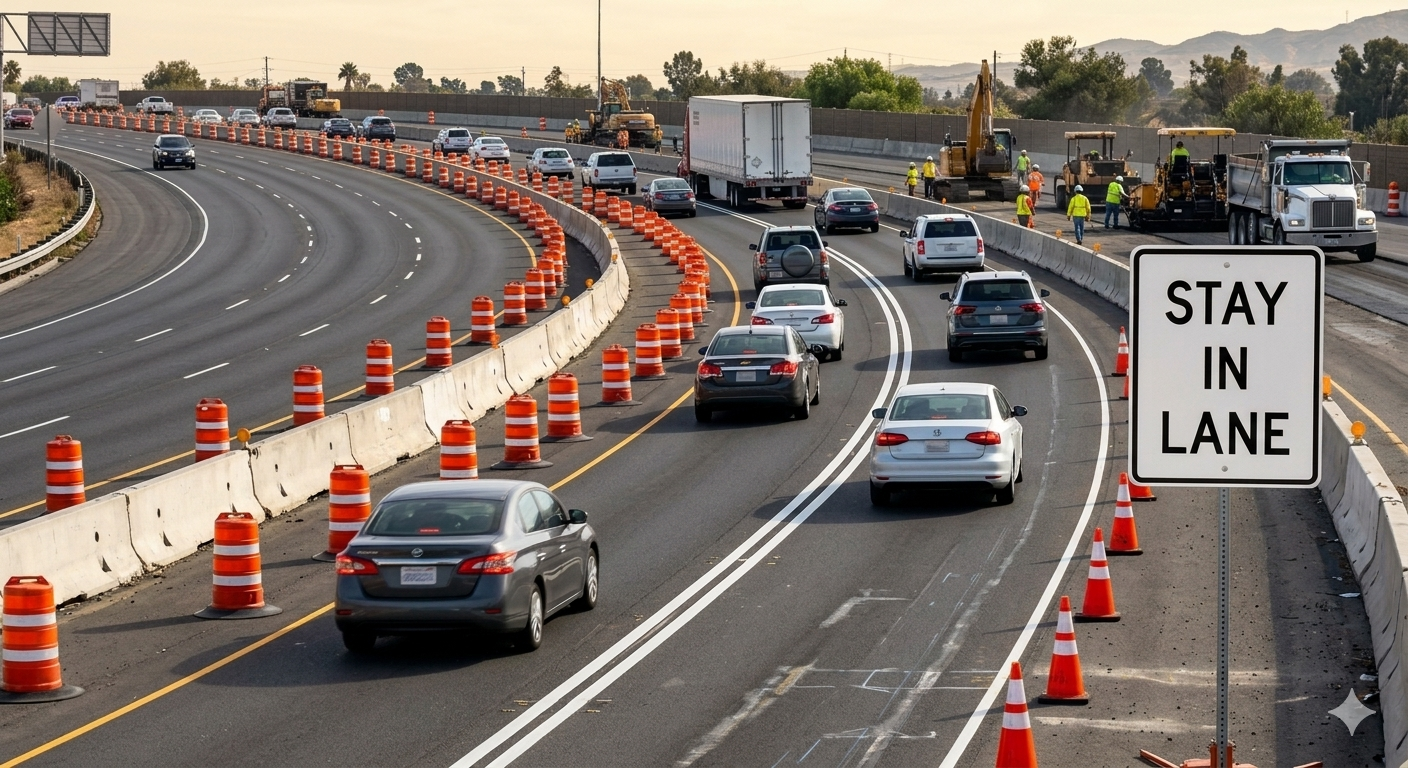
You're driving on a four-lane highway approaching a construction zone. The lanes have shifted slightly — the road is narrower, the geometry feels slightly unfamiliar, and there's a drum line on your left. Mounted on a post to the right, a white rectangular sign reads: STAY IN LANE. That's the R4-9.
It is a regulatory sign formally defined in the Manual on Uniform Traffic Control Devices (MUTCD) 11th Edition, Section 2B.40, within Chapter 2B — Regulatory Signs, Barricades, and Gates. It sits in the R4 series alongside the R4-3 (Slower Traffic Keep Right), R4-7 (Keep Right), and R4-10 (Runaway Vehicles Only) as part of the "Passing, Keep Right, and Slow Traffic" sign family.
The R4-9's job is precise: on a multi-lane highway, it tells every driver on every lane that lane changing is prohibited at this location until conditions permit. It doesn't apply only to slower vehicles or only to trucks — it applies uniformly to all traffic present on all lanes where it is posted. Unlike most lane-discipline signs, which address behavior relative to speed, the R4-9 is absolute. When it's posted, no one changes lanes. Period.
What Does "Stay in Lane" Actually Means?
The instruction is not hedged. "Stay in Lane" means exactly what it says — you must remain in your current lane and not shift laterally into an adjacent lane. There is no speed condition, no relative-flow qualifier. When the R4-9 is posted, every driver on every lane it governs is prohibited from lane changing until the sign's zone ends or conditions otherwise permit the shift.
The MUTCD 11th Edition, Section 2B.40 states the R4-9 "may be used on multi-lane highways to direct road users to stay in their lane until conditions permit shifting to another lane." That phrasing — "until conditions permit" — is important. The sign doesn't imply a permanent prohibition. It identifies a segment of road where the geometry, work activity, sight distance, or traffic management scheme requires all drivers to hold their lane position for the duration of the controlled zone.
"The R4-9 is one of the few regulatory signs in the R4 family that applies universally — to every vehicle in every lane simultaneously, without regard to speed. It is a zone-based absolute lane prohibition, not a behavioral advisory."— Engineer Fix, MUTCD Sign Analysis, 2026
In practical terms, this means a driver in the right lane who wants to move to the left lane to get ahead of a slower vehicle must wait. A driver in the left lane who wants to move right to access an exit must hold position. The sign gives engineers the ability to essentially "freeze" lane assignments on a stretch of roadway for safety or operational reasons — a powerful tool, used sparingly.
Is It a Law or Just Guidance?
The R4-9 is a regulatory sign. Under MUTCD Section 2B.01, regulatory signs carry the full legal authority of the applicable state traffic statutes that adopt the MUTCD. All fifty states have adopted the MUTCD by reference into their transportation law, which means the R4-9's instruction is legally binding wherever it is posted.
In work zones, the legal stakes are higher. Most states have enacted work zone traffic safety laws that increase fines — often double — for moving violations committed within an active construction zone. Where the R4-9 is used in combination with work zone markers, a lane-change violation compounds: it violates the regulatory sign and may trigger enhanced work zone penalties simultaneously.
Appearance, Shape & Color
The R4-9 follows the universal design standard for regulatory signs: white background, black legend, black border, vertical rectangle. The legend reads STAY IN LANE in two stacked lines. No arrows, no symbols, no pictograms — just the plain instruction. The sign's simplicity is intentional: in a work zone or a complex multi-lane interchange, brevity is legibility.
The font is FHWA Series D — Highway Gothic — the same standardized typeface used on speed limit signs, stop signs, and the rest of the regulatory sign family. Clearview is no longer approved for new regulatory sign installations under the 11th Edition of the MUTCD; Series D is the only compliant typeface choice for fabricators manufacturing R4-9 signs today.
The substrate is typically 0.080-gauge aluminum, 3105 alloy, with radius-cut corners and 3/8″ pre-punched mounting holes — the same structural standard applied across the R4 family and most of the regulatory sign spectrum.
IN
LANE
LANE TO
MERGE
POINT
TRAFFIC
KEEP
RIGHT
RIGHT
MUTCD Size Specifications — Table 2B-1
Sign sizing for the R4-9 is drawn directly from MUTCD 11th Edition Table 2B-1, Section 2B.03 — the master regulatory sign size table. The R4-9's required dimensions scale with roadway classification, just like every other regulatory sign, and must meet the minimum size for the facility type where they are installed.
| Road Classification | R4-9 Size (W × H) | Notes |
|---|---|---|
| Conventional Road — Single Lane | 24″ × 30″ | Minimum for single-lane conventional roads |
| Conventional Road — Multi-Lane | 24″ × 30″ | Minimum for multi-lane conventional roads |
| Freeway / Interstate | 36″ × 48″ | Required on all freeway-class facilities |
| Minimum (Low-Volume Rural, ≤30 mph) | 18″ × 24″ | Only applicable on low-volume rural roads ≤30 mph posted |
| Oversized Option | 48″ × 60″ | Available where enhanced visibility is required |
The size differential between a conventional road installation (24″×30″) and a freeway installation (36″×48″) exists because sign legibility must be maintained at greater approach speeds. At 70 mph on an Interstate, a driver covers approximately 103 feet per second. The larger sign ensures the STAY IN LANE message is readable far enough in advance to allow a response — even for a driver who first sights it at the legal minimum legibility distance.
For work zone installations specifically, the applicable sizes are governed by both Section 2B.03 and Part 6 Table 6F-1 (Temporary Traffic Control Zone Sign Sizes). Work zone signs on high-speed roadways are typically required to match or exceed the permanent sign sizes for that facility class.
Retroreflectivity Requirements
The R4-9 is a regulatory sign, and under MUTCD Section 2B.01, all regulatory signs "shall be retroreflective or illuminated." The minimum maintained retroreflectivity for the white background of a regulatory sign is 7.0 cd/lux/m², as established in MUTCD Table 2A-5. This value is the maintained minimum — meaning the sign must not be allowed to fall below this threshold during its service life.
Under MUTCD Section 2A.22, agencies must have an active retroreflectivity assessment or management program in place for all signs, including the R4-9. Three acceptable management methods are defined: visual nighttime inspections by trained inspectors from a moving vehicle; direct measurement using a retroreflectometer; or a blanket sign replacement schedule based on known sheeting degradation rates. The 11th Edition strengthens this requirement — the compliance deadline established in earlier rulings has passed, meaning all agencies should already have an active program.
| Sign Series | Sign Code | Min. Retroreflectivity (White Background) | ASTM Sheeting Min. (Highway) |
|---|---|---|---|
| R4 — Slower Traffic Keep Right | R4-3 | 7.0 cd/lux/m² | Type III HIP |
| R4 — Stay in Lane | R4-9 | 7.0 cd/lux/m² | Type III HIP |
| R4 — Keep Right | R4-7 | 7.0 cd/lux/m² | Type III HIP |
| R2 — Speed Limit | R2-1 | 7.0 cd/lux/m² | Type III HIP |
For work zone R4-9 signs on temporary portable sign stands, the retroreflectivity standard does not change — the MUTCD does not create a lower threshold for temporary signs versus permanent installations. What changes is that temporary signs may cycle through more installations and be exposed to greater handling damage, making active replacement programs more critical in that context.
The Critical Pavement Marking Companion
This is where the R4-9 has a unique requirement that sets it apart from most regulatory signs in the R4 family. MUTCD Section 2B.40 specifically states: if a Stay in Lane sign is used, it should be accompanied by solid double white lane line(s) to prohibit lane changing.
The solid double white line is white's equivalent of a double solid yellow centerline — it communicates "do not cross" to drivers. Where a broken white line between lanes means lane changing is permitted, a solid single white line cautions against it, and a solid double white line prohibits it outright. The R4-9 sign and the solid double white marking work as a paired system — the sign gives the verbal instruction; the pavement marking reinforces it at ground level where drivers are also looking.
-
Solid double white lane line: The primary companion marking for the R4-9. Two adjacent solid white lines — each typically 4–6 inches wide, spaced 4 inches apart — placed in the lane separation between the lanes where the prohibition applies. Under MUTCD Part 3, solid white lane lines prohibit crossing; a double configuration reinforces that prohibition visually.
-
Work zone channelization: In TTC (Temporary Traffic Control) applications, the pavement marking is often supplemented by physical channelizing devices — traffic drums, cones, or barrier systems — that physically prevent lane changes. The R4-9 sign works in coordination with these physical elements to establish the full controlled zone.
-
Retroreflective raised pavement markers: On high-speed facilities, retroreflective raised pavement markers (RPMs) may supplement the solid double white line to maintain lane definition at night and in adverse weather. Per MUTCD Section 3B.14, RPMs may substitute for broken lines but should supplement solid lines rather than replace them.
Where and When Engineers Install It
The R4-9 is not a universal highway sign. Its use is deliberately limited to situations where lane changing creates a genuine safety or operational hazard — not merely where it would be inconvenient. The MUTCD classifies the R4-9 as an "option" (may be used), not a standard (shall be used) or guidance (should be used), which means engineers apply it with engineering judgment at specific problem locations.
-
Multi-lane highway shifts in work zones: The most common application. When construction or maintenance activity forces lanes to shift laterally — even by a few feet — drivers need to hold their lane position through the transition zone. Unexpected lane changes during a shift can create dangerous offset collisions. The R4-9 eliminates that risk by freezing lane assignments through the geometry change.
-
Lane narrowing zones: Where lanes are temporarily or permanently narrowed below standard width — such as near bridge rails, sound walls, or narrow pavement sections — lane changing within the narrowed zone can result in side-swipe collisions. An R4-9 posted at the beginning of the narrowed section instructs drivers to commit to a lane before entering the tighter geometry.
-
Complex interchange diverge points: On some multi-lane diverging sections — particularly where traffic must separate into different exit lanes — engineers may post R4-9 signs at the decision point to prevent late lane changes that could lead to collision or missed exits. This keeps traffic in its intended lane through the high-conflict zone.
-
Tunnels and structures with reduced lateral clearance: In tunnel approaches and on bridges where the structure itself constrains available lateral space, lane changes can bring vehicles dangerously close to fixed objects. The R4-9 establishes lane discipline before drivers enter confined geometry where the consequences of a lateral drift are severe.
-
Late merge taper zones (with R4-9a): When paired with the R4-9a variant at late-merge operations, the R4-9 appears in advance to hold lanes, while the R4-9a appears at the merge point itself. This tandem installation directs drivers to stay in their lane until the physically designated merge point — maximizing road capacity and reducing the queue-jump behavior that degrades late-merge efficiency.
R4-9 vs. R4-9a — The Work Zone Variant
These two signs are closely related but serve distinct purposes within the Temporary Traffic Control framework. Understanding the difference is important for anyone working in traffic engineering, sign fabrication, or highway construction compliance.
- Used on permanent multi-lane highway installations and in work zones where a multi-lane shift has been incorporated
- Instructs drivers to remain in their current lane until conditions elsewhere in the zone permit changing
- Governed by MUTCD Section 2B.40 (permanent) and Section 6G.07 (TTC)
- Posted at or before the beginning of the no-lane-change zone
- Companion: solid double white lane line(s)
- Standard sizes:18×24 , 24×30 , 36×48 , 48×60 per road class
- Work zone-specific variant used exclusively during late merge operations (MUTCD Section 6N.19)
- Instructs drivers to remain in lane until the physically designated merge point — intentionally preventing early merging
- Governed exclusively by MUTCD Section 6G.07 (TTC only)
- Posted in advance of the merge point, directing drivers to commit to their lane and only merge at the merge-point sign
- Companion: same solid double white channelization plus physical merge point signing
- Same base sizes as R4-9 per facility class
The practical difference comes down to what happens at the end of the zone. With a standard R4-9, lane changing is simply permitted again after the zone ends — either because the geometry normalizes or because the restriction ends. With the R4-9a, drivers are being directed to hold their lane until they reach a specific, signed merge point — the goal being maximum lane utilization in high-volume work zone approaches, where early zipper-merging would otherwise create long single-lane queues.
R4-9 vs. Related R4 Signs
The R4 series contains several signs that new engineers and drivers sometimes conflate. The R4-9 has a specific, defined scope. Comparing it to its closest neighbors clarifies when each sign is appropriate and where the R4-9's unique lane-freeze function is necessary versus when a different sign should be used instead.
| Sign | Code | Who It Applies To | What It Prohibits / Requires | Primary Context |
|---|---|---|---|---|
| Stay in Lane | R4-9 | All vehicles, all lanes | Prohibits lane changing in the zone | Work zones, lane shifts, narrow structures |
| Stay in Lane to Merge Point | R4-9a | All vehicles, all lanes | Prohibits lane changing until the merge point | Work zone late merge operations only |
| Slower Traffic Keep Right | R4-3 | Only slower-than-flow vehicles | Requires right-lane use when traveling below prevailing speed | Multi-lane divided highways, climbing lanes |
| Keep Right | R4-7 | All vehicles | Directs all traffic to pass right of a physical obstacle | Median noses, islands, channelized islands |
| Keep Right Except to Pass | R4-16 | All vehicles | Requires right-lane use unless actively passing | High-enforcement left-lane campaigns on Interstates |
The key differentiator for the R4-9 is that it applies universally, regardless of vehicle type or speed, and it prohibits lane changing as a category rather than regulating which lane to be in. The other R4 signs tell you where to be. The R4-9 tells you to stay where you already are.
Common Questions Answered
Is the Stay in Lane sign R4-9 a mandatory regulatory sign?
Yes. The R4-9 is a regulatory sign defined in MUTCD Section 2B.40. Under Section 2B.01, all regulatory signs inform road users of traffic laws and carry legal weight equivalent to state traffic statutes that adopt the MUTCD. Failing to comply with an R4-9 where it is posted can constitute a moving violation — and in work zones specifically, many states apply enhanced fines for work zone traffic violations.
What pavement marking must accompany the R4-9?
MUTCD Section 2B.40 states that if a Stay in Lane sign is used, it should be accompanied by solid double white lane line(s) to prohibit lane changing. The solid double white line pavement marking is the physical enforcement partner of the R4-9 sign — the sign communicates the prohibition verbally; the marking communicates it through the roadway surface where drivers are also visually processing information.
What is the difference between R4-9 and R4-9a?
The R4-9 is the standard Stay in Lane sign used on permanent multi-lane highway installations and in work zones where a multi-lane shift has been incorporated. The R4-9a (Stay in Lane to Merge Point) is a work zone-specific variant used during late merge operations as described in MUTCD Section 6G.07. The R4-9a directs drivers to maintain their lane position until reaching the physically designated merge point — specifically designed to maximize throughput in two-lane-to-one-lane work zone transitions by preventing counterproductive early merging behavior.
What size is the R4-9 on a freeway?
MUTCD Table 2B-1 specifies the R4-9 at 36×48 inches for freeway-class facilities. On expressways the standard size is 24×30 inches, and on conventional roads — both single-lane and multi-lane columns — the standard size is 24×30 inches. An oversized option at 48×60 inches is available where conditions require enhanced visibility. On low-volume rural roads posted at 30 mph or less, an 18×24-inch minimum may be used.
Can the R4-9 be used on a two-lane road?
Technically, the MUTCD defines the R4-9 as applicable to multi-lane highways — the sign text and purpose presuppose a situation where adjacent travel lanes exist and lane changes are otherwise an option. On a standard two-lane undivided road with no adjacent parallel lane to change into, the R4-9 would have no practical application. Two-lane roads use passing zone markings (double solid yellow) and no-passing zone signs (R4-1) to regulate similar lane-positioning behavior.